
Planes of Human Development
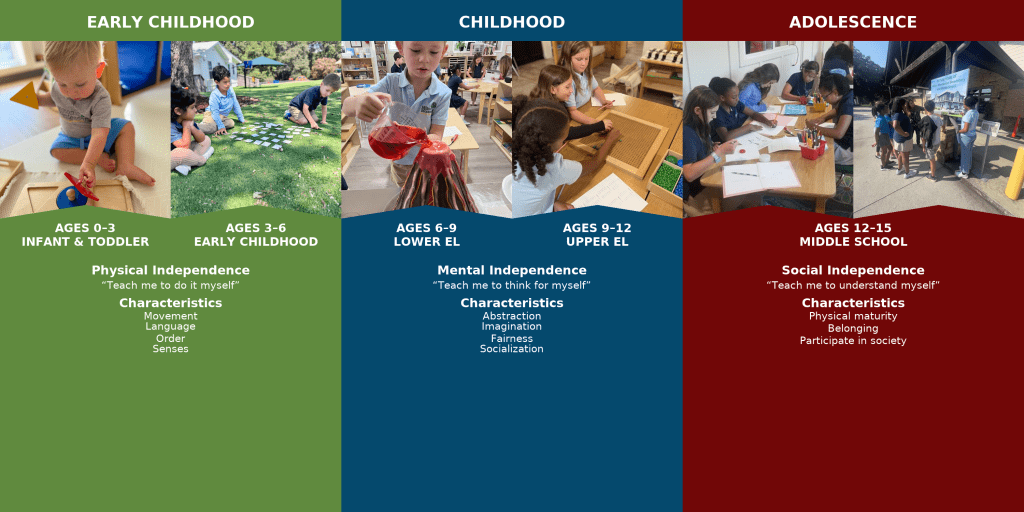
Children grow and change through distinct developmental stages on their journey from birth to adulthood. Montessori education adapts at each stage to align with the evolving needs, interests, and characteristics of the child.
During the first plane of development, from birth to age six, children possess what Dr. Montessori called an absorbent mind—they naturally and effortlessly take in everything from their environment, including language and cultural norms. This stage is also marked by sensitive periods, windows of time when learning certain skills happens more easily and effectively.
From ages six to twelve, in the second plane, children shift toward a reasoning mind. They begin to think more abstractly, use logic, and engage their imaginations to explore and understand the world around them.
In the third plane, from twelve to eighteen, adolescents develop what Montessori called a humanistic mind. They become deeply interested in questions of ethics, identity, and their role in society, seeking to find meaning and purpose through social connection and contribution.
Finally, in the fourth plane, from eighteen to twenty-four, young adults use a specialist mind, focusing their energy on specific areas of study or work as they prepare to take their place in the wider world.
Maria Montessori believed that when education is aligned with the natural course of human development, it nurtures not just the individual, but also contributes to a more peaceful, cooperative, and harmonious society.